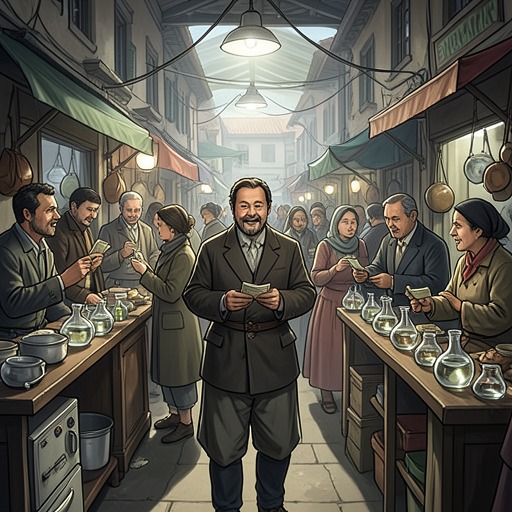
Breckinridge Scott
World War ZBreckinridge Scott, also called Breck Scott and later condemned as the “Phalanx king,” is one of the clearest embodiments of commercial opportunism in the aftermath of the Great Panic. He recognizes fear as a commodity, converts an outbreak into a market for manufactured protection, and survives the collapse by withdrawing to Vostok Station, where his wealth gives him physical isolation but not moral immunity.
Identity and Stronghold
Breckinridge Scott leases Vostok Station from the Russian government and remains there after the Great Panic. The station is situated near the southern geomagnetic pole, on the four-kilometer ice crust of Lake Vostok, in a climate where temperatures have reached a world-record negative eighty-nine degrees Celsius and rarely rise above negative twenty-two. Overland transport takes more than a month, making the outpost exceptionally difficult to reach. Scott further improves the facility, including its reinforced geodesic greenhouse, “The Dome,” powered by the station’s geothermal plant. The setting is therefore not merely a refuge but the physical expression of his method: wealth purchases distance, infrastructure, and time against a disaster that ordinary people cannot escape.
His Antarctic isolation also sharpens the contrast between private survival and public ruin. While societies struggle with the consequences of the outbreak, Scott remains in a fortified environment built from resources accumulated before and during the crisis. The remoteness that once made Vostok attractive becomes part of his identity as a fugitive capitalist, protected by geography and technology while the consequences of his enterprise spread elsewhere.
The Business of Fear
Scott explains his economic philosophy through a maxim learned from a history professor at Wharton: fear is the most valuable commodity in the universe. He treats fear as primal, universal, and therefore endlessly marketable. His repeated formulation, “Fear sells,” is not a passing slogan but the operating principle behind his decisions. Aging, loneliness, poverty, and failure all become examples of anxieties that can be attached to products and converted into revenue.
When reports of the disease still called African rabies first appeared, Scott immediately saw what he regarded as the opportunity of a lifetime. The Cape Town outbreak received only a short period of actual reporting before television devoted much longer coverage to speculation about the virus reaching the United States. Scott responds within seconds by contacting his associates. The crisis does not first appear to him as a humanitarian emergency or a medical puzzle; it appears as an opening in the market, created by public dread and amplified by mass media.
Phalanx and the Manufactured Solution
Scott and his associates develop a pitch for a genuine vaccine against rabies, relying on contacts in the biomedical industry, Congress, and Pennsylvania Avenue. They claim that a working prototype can be produced in less than a month and that a proposal can be prepared within days. Their agreement is effectively sealed on a golf course, where handshakes turn fear into a coordinated commercial and political project.
The central deception depends on technical literalism. The authorities tell the company that the disease is rabies, so the company makes a rabies vaccine; Scott insists that they never technically lied. The vaccine is described as tested in Europe, with its component drugs also tested there, allowing the people involved to preserve a narrow defense of factual correctness while concealing the decisive truth: the virus is not rabies. Their language turns the difference between a technically defensible statement and an honest medical account into a business strategy.
Phalanx is made a prescription drug, ensuring that doctors have financial interests tied to its circulation. Regulatory institutions also become invested in the product: the Federal Drug Administration permits it to pass, congressmen vote for acceptance, and other official figures gain the opportunity to appear heroic. Scott describes the arrangement as a win-win situation because every participant can make money while claiming to protect the public. Six months after Phalanx reaches the market, cheaper knockoff brands appear, followed by related products such as home air purifiers.
The products do not need to work in the way consumers imagine. The virus is not airborne, so air purifiers cannot address its principal method of transmission. Scott acknowledges that this does not matter because the products retain the Phalanx brand association and can be advertised with the cautious claim that they “May Prevent Some Viral Infections.” He sells purifiers for homes and cars, as well as a small device worn around the neck while flying, while admitting that he does not know whether it could even filter ragweed. The commercial system succeeds by preserving the emotional aura of protection after the medical premise has failed.
Exposure, Survival, and Reckoning
Scott’s defense rests on a network in which responsibility is dispersed among manufacturers, physicians, regulators, legislators, and the executive establishment. Because each group gains money or prestige, each has reason not to expose the others. The result is a form of collective complicity in which no single participant needs to acknowledge the whole fraud, even though the public bears the consequences.
After the war, Scott remains hidden in what Arthur Sinclair calls his “Antarctic Fortress of Scumditude.” The phrase combines the location’s formidable isolation with a direct moral judgment: Vostok is a fortress built not only against the undead but against accountability. Scott’s wealth has allowed him to outlast the immediate collapse, yet the new authorities are already discussing the nonrenewal of his lease with Ivan. People in the United States are waiting to see him, especially the Internal Revenue Service. His survival therefore does not conclude his story with vindication. It marks the beginning of a possible reckoning, in which the man who monetized public fear may finally be forced back into the society whose panic made him rich.
Narrative and Thematic Significance
Scott’s account is delivered with blunt self-exposure. He speaks directly about capitalism, media speculation, regulatory complicity, and the sale of useless goods, often presenting incriminating facts in the language of clever business success. That manner creates distance rather than inviting sympathy: the reader is made to examine the machinery of exploitation instead of being carried toward a redemptive portrait of a survivor.
His character links the outbreak’s biological danger to the social danger of commodified fear. The threat is not only that a virus can destroy bodies; it is that institutions can transform uncertainty into demand, demand into profit, and profit into political protection. Phalanx becomes a brand whose name continues to sell long after its medical justification has collapsed. Scott’s Antarctic refuge completes the irony. He can purchase shelter from the world, but he cannot make the consequences of his decisions disappear, and the renewed American financial order identifies him as one of the “big fish” whose wealth must be investigated.